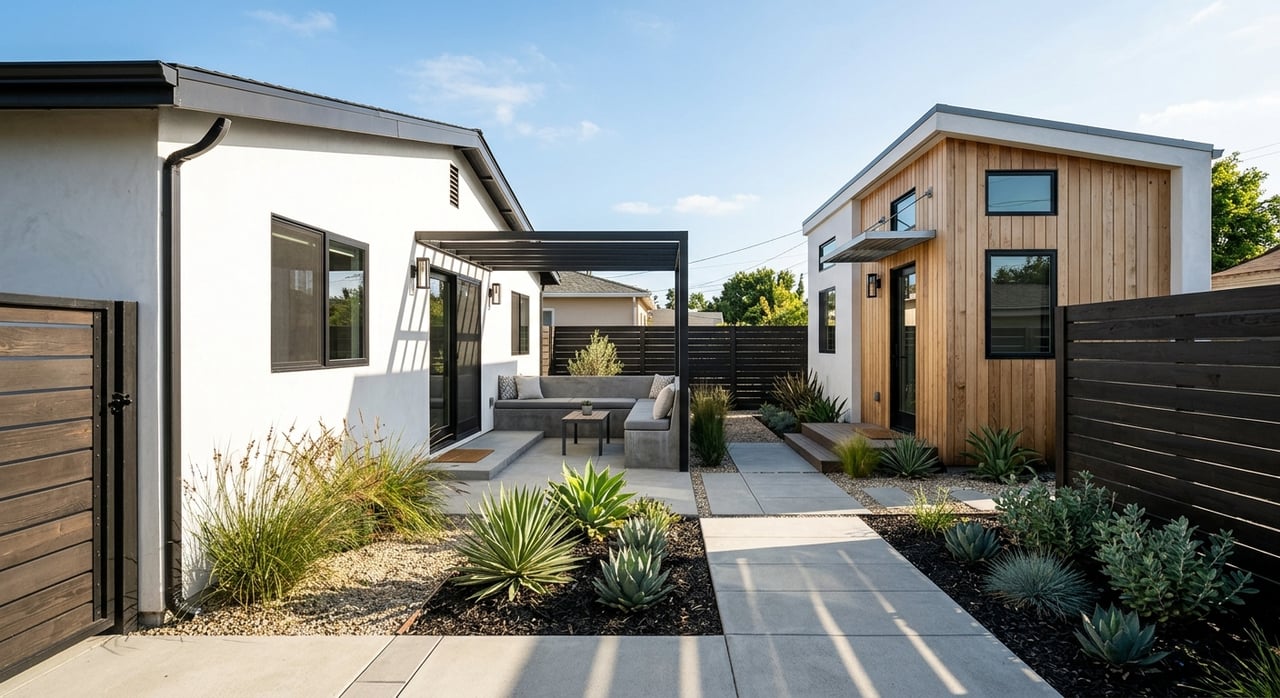
If you are looking at Anaheim for your next investment move, it is easy to see the appeal. Strong visitor demand, major redevelopment near the Honda Center, and steady rental demand can make the city look like a natural fit for short-term rentals or an ADU strategy. The catch is that Anaheim treats those paths very differently, so the best investment often comes down to what is legally possible on a specific property. This guide will help you understand the rules, compare the numbers, and focus on the opportunities that make the most sense in Anaheim. Let’s dive in.
Why Anaheim draws investor attention
Anaheim sits in a unique position for investors because it has both tourism-driven demand and everyday housing demand. That creates interest in both short-term rentals and small-scale long-term housing strategies like ADUs.
A big part of that story is the OCVIBE project, a 92-acre development around Honda Center and ARTIC with phased openings starting in 2026 and construction expected through about 2030. The project includes apartments, hotels, offices, retail, parks, and parking, which could support more visitor traffic and longer-stay demand while also adding new lodging and housing supply.
At the same time, acquisition costs remain meaningful. The research report notes that Anaheim’s median sale price reached $910,000 in February 2026, which means investors need to underwrite carefully and avoid assuming that demand alone will make a property cash flow.
Short-term rentals in Anaheim
New STR permits are mostly off the table
This is the most important starting point for any Anaheim investor. Under Anaheim’s Short-Term Rental Program and ordinance, the city requires a permit before an owner can rent or even advertise a short-term rental, and the opening of entirely new STRs remains prohibited under current policy.
That means Anaheim is not a market where you can usually buy a home and launch a new vacation rental. Most legal STR activity comes from existing permitted properties, with only limited relocation exceptions for certain CC&R-restricted and pre-moratorium properties.
The city has also reported 222 active STR permits and 19 relocation-eligible permits, with more than half of the active permits located in District 4. In practical terms, the legal STR inventory is limited and concentrated rather than widely available across Anaheim.
Anaheim STR rules are strict
If you are evaluating an existing permitted STR, compliance matters just as much as revenue. Anaheim defines a short-term rental as a stay of fewer than 30 consecutive calendar days in a residential zoning district, and the permit is issued to the owner, not the manager.
According to the city ordinance and staff materials, Anaheim requires:
- A minimum stay of three consecutive nights
- A local contact for compliance
- Guest age minimum of 21 or older
- Quiet hours from 10 p.m. to 9 a.m.
- Compliance with good-neighbor standards
- Limits on parking, generally using the driveway or garage
The city also places occupancy limits based on bedroom count. For example, a 2-bedroom STR is capped at 7 occupants, while a 3-bedroom STR is capped at 9 occupants, based on the city’s published fact sheet in the 2024 staff report.
Just as important, Anaheim says STRs may not be used for weddings, parties, receptions, conferences, commercial functions, or other non-lodging gatherings. That limits the upside some investors may expect from event-style use.
Taxes and operating costs matter
Anaheim’s transient occupancy tax is 15% of the rent charged by the operator, and it must be separately stated. That is a major line item in any STR pro forma.
There are also compliance costs beyond the tax itself. The city requires annual permit renewal, and if ownership changes, the owner must file a change-of-ownership application within 14 days. The research report notes that this application carries a $498 fee.
Even if you use a property manager or agent, the city still places responsibility on the owner. So before you look at gross revenue estimates, make sure you are also accounting for tax filing, parking management, local-contact coverage, repairs, utilities, insurance, and recordkeeping.
What STR income can look like
Public dashboards show that Anaheim STR performance can vary quite a bit. One Airbtics Anaheim snapshot cited in the research report showed median revenue of $87,000, 78% occupancy, and a $202 average daily rate for one 12-month period, while another public snapshot for an earlier period showed the same occupancy but a much higher ADR.
That gap is a useful reminder that not all STRs perform the same. Location, layout, amenities, management quality, and legal status all affect results, so conservative underwriting is key.
Here is a simple illustration from the research report:
| Scenario | Occupancy | ADR | Annual Gross Revenue | 15% TOT | Revenue Before Other Expenses |
|---|---|---|---|---|---|
| Existing permitted 2BR STR | 60% | $275 | $60,225 | $9,034 | $51,191 |
| Stronger 2BR STR scenario | 75% | $325 | $89,050 | $13,358 | $75,693 |
These are examples, not guarantees. They also do not include cleaning, utilities, management, maintenance, insurance, financing, or vacancy risk beyond the assumed occupancy level.
ADUs offer a different path
ADUs are often more flexible than STRs
For many Anaheim investors, an ADU is the more realistic strategy. Unlike new STRs, ADUs are supported by state law and Anaheim’s local code, though each property still needs parcel-level review.
Anaheim’s ADUheim page explains that most ADUs and JADUs go through the standard building review process. Qualified single-family properties may use ADU Express, which can complete review in as little as 1 to 3 days.
The city also offers a free pre-approved plan catalog, which can help reduce design costs and shorten the planning timeline. Available plans currently include:
- 224 square foot studio
- 499 square foot 1-bedroom
- 990 square foot 2-bedroom
- 1,199 square foot 3-bedroom
What Anaheim allows for ADUs and JADUs
Anaheim’s municipal code allows ADUs and JADUs in both single-family and multifamily areas, subject to state law and site-specific conditions. On a single-family lot, the code allows one interior or conversion ADU, one new detached ADU, and one JADU, with a total cap of four dwelling units on the lot including the primary residence.
On existing multifamily lots, the rules can be even more interesting for investors. The code allows at least one ADU within the existing building, up to 25% of the existing units, and up to eight detached ADUs so long as the detached ADUs do not exceed the number of existing multifamily units on the lot.
Anaheim also allows detached ADUs up to 1,200 square feet and JADUs up to 500 square feet. Depending on the lot and the existing improvements, that can create a meaningful long-term income opportunity.
Parking and owner-occupancy rules can help
One reason ADUs are often more workable than people expect is parking flexibility. The state ADU handbook says parking cannot exceed one space per ADU or bedroom, guest parking cannot be required, and parking cannot be required in several common situations, including when the ADU is within one-half mile walking distance of transit or is created within the primary home or an accessory structure.
The handbook also says no replacement parking is required when a garage or other parking space is demolished or converted for an ADU. Anaheim’s code aligns with that approach.
Owner-occupancy is another key distinction. In general, local agencies cannot require owner occupancy for ADUs, while JADUs can carry owner-occupancy requirements when sanitation facilities are shared. For many investors, that makes an ADU the more flexible rental option, while a JADU may work better as an owner-user or family-housing strategy.
ADU risks and limits to review
ADUs are easier than STRs in Anaheim, but they are not automatic. Parcel-level due diligence still matters.
Anaheim’s code says ADUs are not permitted in areas the city has identified as having insufficient sewer infrastructure. The code also restricts ADUs on parcels that have obtained a two-unit development and urban lot split permit, and historic properties may face extra design standards.
On the permitting side, the city’s forms and applications page notes that complete applications must be checked for completeness within 15 business days and approved or denied within 60 days. The research report also notes that projects submitted on or after January 1, 2026 must comply with the 2025 California Building Codes and Anaheim amendments.
That means the best approach is to confirm zoning, parcel constraints, infrastructure, and code path before you spend too much time on rent projections.
What ADU income can look like
ADU income is usually steadier than STR income, even if the monthly revenue is lower. The research report cites broader Anaheim rent benchmarks from RentCafe and Zumper, with citywide figures suggesting that a well-finished smaller unit may reasonably underwrite in the low- to mid-$2,000s per month.
As simple examples from the research report:
- $2,100 per month equals $25,200 annually
- $2,700 per month equals $32,400 annually
That lower headline income can still be attractive because the operating profile is usually simpler. Compared with STRs, ADUs generally involve less ongoing compliance friction once built, even though the upfront construction cost can be substantial.
STR versus ADU in Anaheim
If you are comparing both paths, the real question is not which one sounds more exciting. It is which one is legal, practical, and durable for the property you are considering.
| Strategy | Main Advantage | Main Limitation | Best Fit |
|---|---|---|---|
| Existing permitted STR | Higher revenue potential in the right setup | New STRs are generally prohibited, with strict operating rules and 15% TOT | Buyers acquiring a legally permitted property and prepared for active management |
| ADU | More flexible long-term use and steadier underwriting | Requires upfront construction, site review, and permit approval | Owners and investors seeking durable rental income or added housing value |
| JADU | Lower-cost way to add housing in some cases | May involve owner-occupancy requirements | Owner-users or family-housing strategies |
For most buyers in Anaheim, ADUs provide the broader opportunity set. For a smaller group of investors, an existing legal STR may still be valuable, but only if you verify the permit status and operating requirements first.
A smart investment approach in Anaheim
Anaheim is not a market for assumptions. It is a market for verification.
If you are considering a property for STR use, start by confirming whether there is a valid legal path under Anaheim’s current rules. If you are considering an ADU, review the parcel, zoning, sewer capacity, parking rules, and permit timeline before you finalize your numbers.
That kind of local review can save you time, money, and frustration. If you want help evaluating Anaheim properties for investment potential, Kott & Co. can help you look at the real estate first, then match the strategy to the property and the rules.
FAQs
Can you start a new short-term rental in Anaheim?
- In most cases, no. Anaheim’s current policy says entirely new STRs remain prohibited, with only limited exceptions tied to certain relocation situations and legacy conditions.
What counts as a short-term rental in Anaheim?
- Anaheim defines a short-term rental as a stay of less than 30 consecutive calendar days in a residential zoning district.
What is the Anaheim transient occupancy tax for STRs?
- Anaheim charges a 15% transient occupancy tax on rent charged by the operator, and it must be separately stated.
Are ADUs allowed on single-family lots in Anaheim?
- Yes. Anaheim’s code allows ADUs and JADUs on single-family lots, subject to state law, local code standards, and parcel-specific conditions.
How large can a detached ADU be in Anaheim?
- Anaheim’s code allows detached ADUs up to 1,200 square feet.
Do Anaheim ADUs require owner occupancy?
- Generally, ADUs do not carry owner-occupancy requirements, but JADUs can in certain cases, especially when sanitation facilities are shared.
Is an ADU or STR better for Anaheim investors?
- For many investors, an ADU is the more flexible and realistic option because new STRs are generally prohibited, while ADUs are supported by state law and Anaheim’s local ordinance.